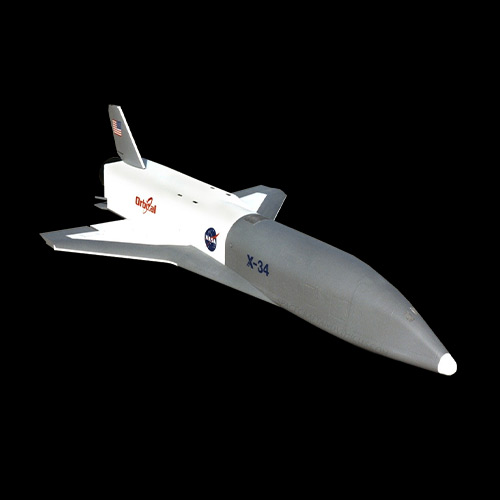
The Orbital Sciences X-34 was an experimental suborbital spaceplane developed by Orbital Sciences Corporation in partnership with NASA. It aimed to demonstrate advanced technologies for reusable launch vehicles (RLVs) and pave the way for more cost-effective access to space.
Design and Construction
The X-34 featured a sleek, aerodynamic design with delta-shaped wings and a distinctive lifting body fuselage. It was constructed primarily from lightweight composite materials to enhance structural integrity while minimizing weight. Engineering challenges included the development of advanced thermal protection systems and aerodynamic control surfaces.
Mission Objectives
The primary mission objective of the X-34 program was to validate key technologies for future RLVs, including aerodynamics, propulsion, and thermal protection systems. Secondary objectives included testing autonomous flight control systems and evaluating operational procedures for rapid turnaround between flights.
Launch and Deployment
The X-34 was designed to be air-launched from a modified L-1011 carrier aircraft at high altitude. Following release, its onboard rocket engine would ignite, propelling the vehicle to suborbital altitudes for a series of test maneuvers. However, the program faced setbacks and funding issues, leading to its cancellation before a complete flight test program could be conducted.
Technical Specifications
- Dimensions: Length X meters, Wingspan X meters
- Weight: X kilograms
- Payload Capacity: X kilograms
- Propulsion: Rocket engine (type TBD)
- Power Source: Not applicable (suborbital flight)
- Instruments and Equipment: Flight control systems, avionics, payload integration capability.
Current Status
The X-34 program was canceled in 2001 before a full flight test program could be completed. Despite its premature end, the lessons learned from the X-34 program contributed to the development of subsequent spaceplane concepts and advancements in reusable launch vehicle technology.