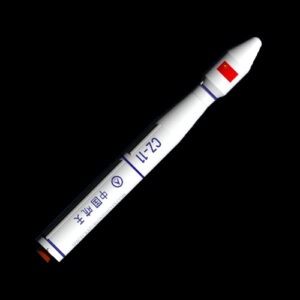
The Long March 1 (长征一号), also known as Changzheng-1 (CZ-1), was China‘s inaugural orbital launch vehicle and the first in the Long March rocket family. Developed in the 1960s, it was derived from the Dong Feng 4 (DF-4) intermediate-range ballistic missile, modified with an additional third stage to achieve the necessary velocity for orbital insertion.
Design and Construction
Standing approximately 29.86 meters (98 feet) tall and measuring 2.25 meters (7 feet 5 inches) in diameter, the Long March 1 had a liftoff mass of about 81,570 kilograms (179,830 pounds). It was capable of delivering payloads up to 300 kilograms (660 pounds) into low Earth orbit (LEO).
The launch vehicle featured a three-stage configuration:
First Stage: Powered by a YF-2A engine, comprising four YF-1A engines, utilizing unsymmetrical dimethylhydrazine (UDMH) as fuel and AK27S (a nitric acid oxidizer) as the oxidizer.
Second Stage: Equipped with a YF-3A engine, also burning UDMH and AK27S.
Third Stage: Known as FG-02, this solid-propellant stage used a polysulfide and ammonium perchlorate (AP) mixture.
Mission Objectives
The Long March 1’s most notable mission occurred on April 24, 1970, when it successfully launched China’s first satellite, Dong Fang Hong 1, into orbit, making China the fifth nation to achieve independent satellite launch capability.
Launch and Deployment
The rocket had a brief operational period, with only two launches between 1970 and 1971, both of which were successful. Following these missions, it was retired in favor of more advanced launch vehicles in the Long March series.
Technical Specifications
- Height: 29.86 meters (98 feet)
- Diameter: 2.25 meters (7 feet 5 inches)
- Mass: 81,570 kilograms (179,830 pounds) at liftoff
- Payload Capacity: Up to 300 kilograms (660 pounds) to low Earth orbit (LEO)
- Propellant Type: Liquid (UDMH as fuel and AK27S as oxidizer for first and second stages)
- Stages: Three-stage configuration (First and second stages with liquid propellant, third stage for orbital insertion)
Current Status
The development and success of the Long March 1 marked a significant milestone in China’s space exploration efforts, laying the groundwork for the country’s subsequent advancements in launch vehicle technology.